![WEARABLE_INSIGHT [FORUM]](https://wearableinsight.net/wp-content/uploads/2025/04/로고-3WEARABLE-INSIGHT1344x256.png)




Is GATT (Generic Attribute Profile) the most widely used data transfer protocol between wearable devices and smartphones/tablets, and indeed the closest to a “standard” option?

Is GATT (Generic Attribute Profile) Good for Data Transmission Between Wearables and Smartphones/Tablets? → “Absolutely Yes.”
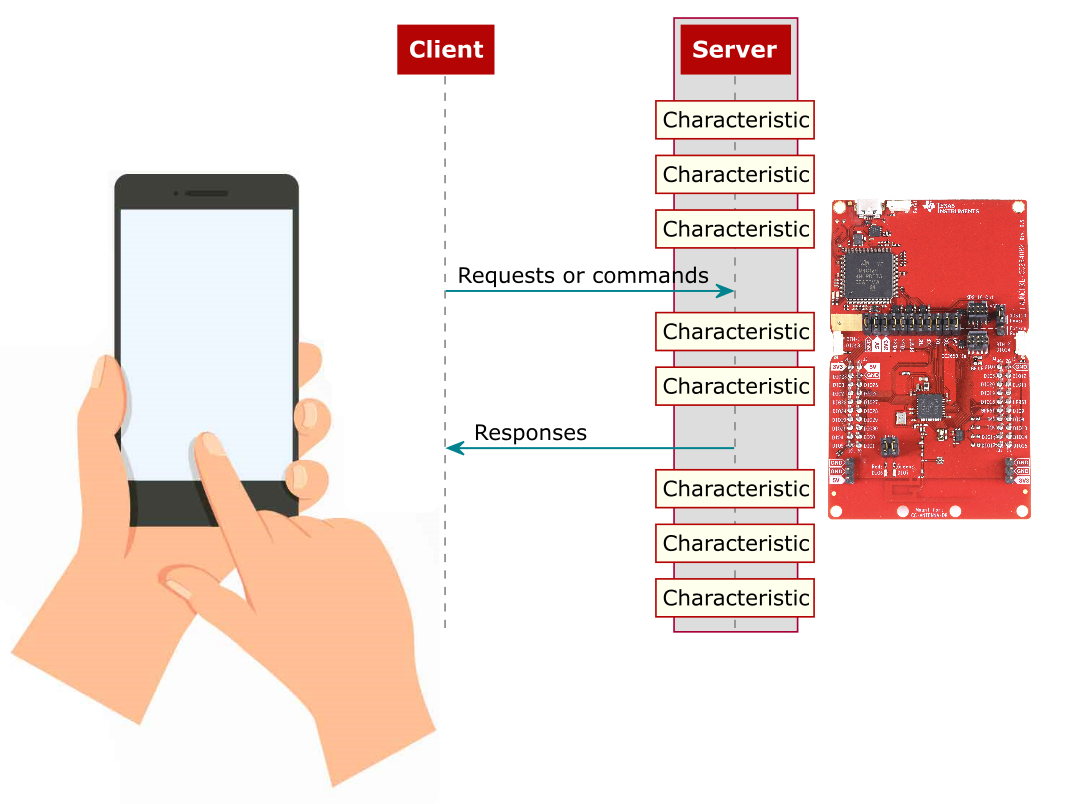
[출처 : https://software-dl.ti.com/lprf/sdg-latest/html/ble-stack-3.x ]
GATT, which runs on top of Bluetooth Low Energy (BLE), is essentially the industry standard for communication between wearable devices and mobile platforms.
[Why GATT Fits Wearable Devices So Well]
1) Ultra-low power consumption
Wearables have small batteries. GATT over BLE is designed for long operational time with minimal energy usage.
2) Great for continuous data streaming
Perfect for transmitting ongoing sensor values such as:
-
heart rate
-
steps/IMU data
-
temperature
-
barometric pressure
3) Attribute-based structure (Service → Characteristic → Descriptor)
This makes it easy to organize and manage sensor categories cleanly and consistently.
4) Fully bidirectional
Wearables → Phone: sensor data, notifications
Phone → Wearables: mode changes, configuration, control, and even firmware updates (DFU).
5) Universal compatibility
iOS, Android, Windows, and major OS platforms provide native BLE APIs.
[How GATT Is Used Inside Wearables]
Wearables typically define specific Services and Characteristics, for example:
Standard Services
-
Heart Rate Service
-
Heart Rate Measurement (Notify)
-
Body Sensor Location (Read)
-
-
Battery Service
-
Battery Level (Read/Notify)
-
Custom Services (for accelerometers, IMUs, haptics, pressure sensors)
-
Accel X/Y/Z (Notify)
-
Operation Mode (Read/Write)
-
Haptic Intensity (Write)
In practice:
-
Sensor values are sent via Notify
-
Settings and commands use Write or Write Without Response
[Key Advantages of GATT]
1) Excellent power efficiency
Ideal for always-on wearable devices.
2) Fast enough for real-time sensor streaming
BLE provides sufficient throughput for most physiological or motion sensors.
3) Low latency
Essential for haptics, biofeedback, real-time fitness analysis.
4) Easy app development
Both iOS and Android offer well-documented GATT interfaces.
[Limitations of GATT]
1) Not ideal for large data transfers
Firmware images, audio, large files require chunking and can be slow.
2) Small packet size
Default MTU is 20 bytes (expandable to 185 bytes), meaning data segmentation is necessary.
3) Can be affected by interference
Multiple BLE devices in proximity may cause instability in noisy RF environments.
[Summary]
“GATT is extremely suitable for wearable-to-smartphone/tablet data communication and functions as a de facto standard in the wearable industry.”
➡ For sensor data transmission, GATT + BLE is the optimal and most widely adopted approach.
It checks every major requirement:
-
Low-energy operation
-
Reliable, continuous connection
-
Adequate throughput for sensor streams
-
Strong OS-level compatibility
-
Clear Service/Characteristic model
GATT remains the first choice for nearly all wearable device designs.
